'Cap Guard'
A 'soft-start' means for power supply circuit where a silicon bridge rectifier is used
 OR SOME TIME I have been figuring out how to provide a way of protecting the amplifier circuit(s) from the initial high voltage switch-on surge before the valves begin conducting and loading the PSU to drop the voltage to the normal working level. Alternatively, a rectifier valve will normally provide this action, but is an added expense and uses more power, so the problem remains where the cheaper option solid-state bridge rectifier is used. Frequently early designs of this type featured a series thermistor between the bridge '+' output and the reservoir cap.
Using Zener diodes and/or Voltage Dependent Resistors (VDR) to limit the supply rails at strategic points is not a practical solution since the power handling required of these devices is enormous given the high voltage drop involved, such high power devices are awkward to find and the circuit starts becoming complicated.
A relatively cheap and simple alternative that I thought of is to borrow an idea I have seen used in bench power supplies, where a relay is used to switch between different voltage taps on the mains transformer secondary. In the case of the bench supply, it was to reduce the power dissipation of the series regulator power transistor at low outputs. When this state is detected, a lower secondary tap is selected thereby reducing the rectified DC and hence the voltage drop across the series regulator.
How this might be applied to our case for a diode bridge rectified valve amp PSU is illustrated below:
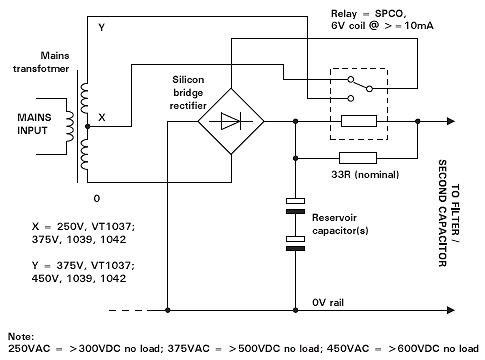

The relay's coil is in series between the rectified DC from the reservoir capacitor, and the following 'pi' LC filter arrangement (or at least another capacitor). For a so-called miniature 6V coil SPCO (Single Pole Change-Over) type, having a typical coil resistance in the range of 50 - 70 Ω, the current will typically be 10 - 20% of the total HT current, therefore a shunt resistor is necessary.
The relay's normally closed position selects the lower voltage tap on the mains transformer secondary. The idea is that as the output valves begin to conduct, the current increases until the relay is energised, thus switching over to the high voltage tap, where it will remain. For example, a stereo Millennium amp will draw at least 250mA.

2010
I am also currently working on a current shunt idea using a power MOSFET, works like a high power Zener.
The relay's normally closed position selects the lower voltage tap on the mains transformer secondary. The idea is that as the output valves begin to conduct, the current increases until the relay is energised, thus switching over to the high voltage tap, where it will remain. For example, a stereo Millennium amp will draw at least 250mA.
2010
I am also currently working on a current shunt idea using a power MOSFET, works like a high power Zener.
